




Coconut Water vs Alcohol: What Is Your Daily Drink Doing to Your Body?
One Gives Your Body Hydration. The Other Comes With Hidden Health Risks.
Every day, millions of people choose what to drink based on taste, habit, social culture or health beliefs. Some prefer a glass of fresh coconut water, while others enjoy beer, red wine or whisky after a long day.
But have you ever wondered what happens when someone drinks 300 ml of coconut water every day compared with someone who regularly consumes an alcoholic drink?
Is red wine really good for the heart? Is beer less harmful than whisky? Does coconut water actually provide more health benefits?
Let’s explore the facts.
1. Coconut Water: Nature’s Refreshing Drink
Coconut water is the naturally occurring liquid inside a tender coconut. It contains water, electrolytes, potassium, magnesium and small amounts of natural sugars.
Benefits of Drinking 300 ml Coconut Water
1. Supports Hydration
Coconut water helps replenish fluids and electrolytes, especially after sweating or physical activity.
2. Provides Potassium
Potassium supports normal muscle function, nerve activity and blood pressure regulation.
3. Contains Natural Minerals
It provides small amounts of magnesium, calcium and other minerals that contribute to normal body functions.
4. Naturally Alcohol-Free
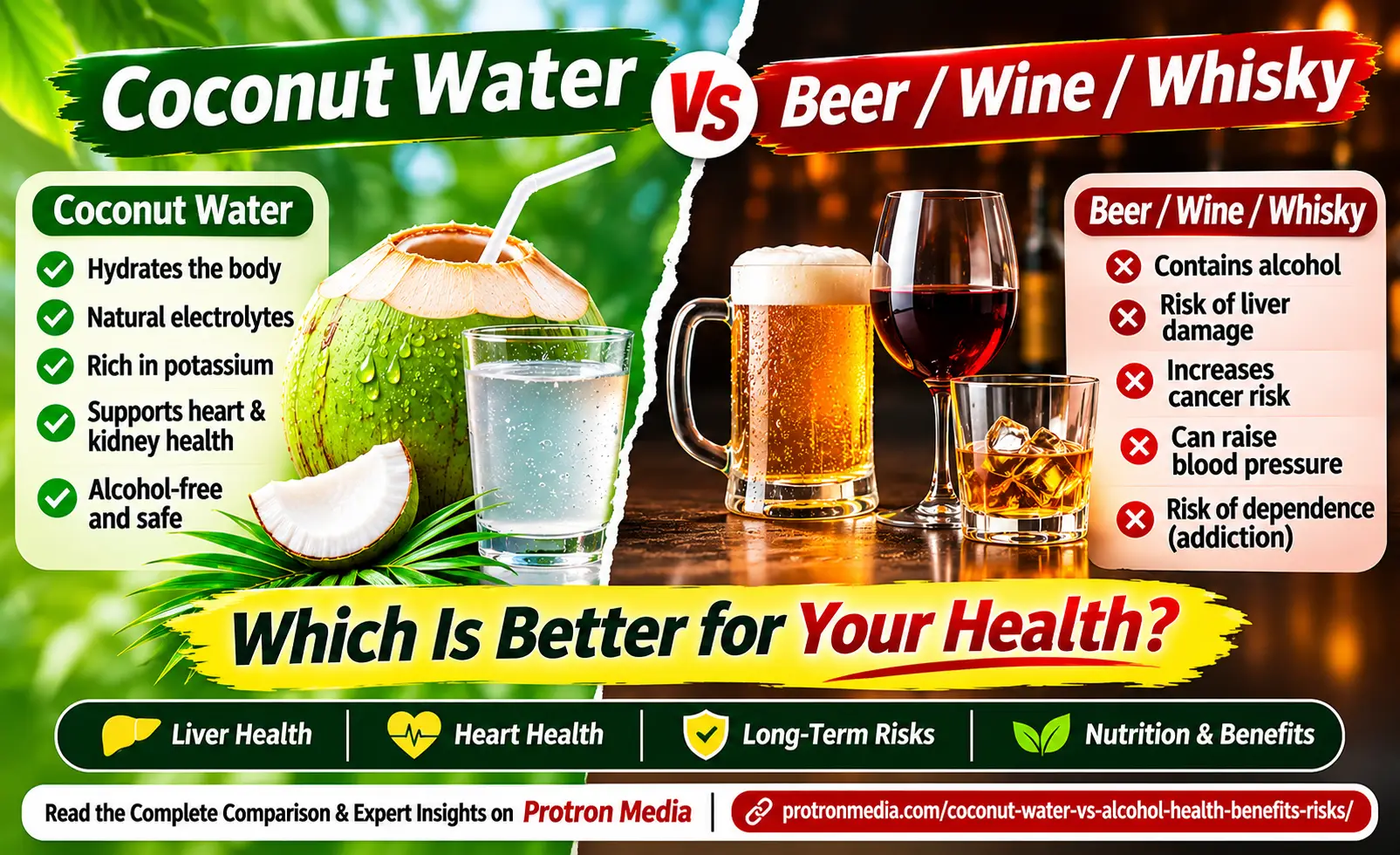
Unlike beer, wine and whisky, coconut water contains no alcohol and does not cause intoxication or alcohol dependence.
5. A Better Alternative to Sugary Drinks
Unsweetened coconut water can be a refreshing alternative to soft drinks and artificially sweetened beverages.
Possible Disadvantages
- Contains natural sugar, so people with diabetes should account for its carbohydrate content.
- Excessive consumption adds unnecessary calories and sugar.
- People with kidney disease or high potassium levels may need to limit it.
- It is not a substitute for plain drinking water.
2. Beer: Popular, But Is It Healthy?
Beer is one of the most commonly consumed alcoholic beverages worldwide. It is generally made from water, malted grains, hops and yeast.
What People Consider Its Benefits
- Beer contains small amounts of certain B vitamins and minerals.
- It may contain some polyphenols from grains and hops.
- Some people consider moderate beer consumption a way to relax socially.
However, these nutritional components do not establish beer as a health-promoting drink.
Health Risks of Regular Beer Consumption
- Alcohol increases the risk of certain cancers.
- Regular consumption can contribute to weight gain.
- It can increase blood pressure.
- It can contribute to fatty liver and other liver diseases.
- It can affect sleep quality and mental health.
- It can lead to alcohol dependence.
Important: Beer is not harmless simply because it generally has a lower alcohol concentration than whisky.
3. Red Wine: The Heart Health Myth
Red wine is often associated with antioxidants and heart health because it contains polyphenols, including resveratrol.
What Are Its Potential Benefits?
- Contains polyphenols from grape skins.
- Provides antioxidant compounds.
- Resveratrol has been studied for its potential biological effects.
But Here Is the Reality
The presence of antioxidants does not mean drinking red wine improves your health.
Research has not established that drinking red wine prevents heart disease or increases life expectancy.
Health Risks
- Increases the risk of several types of cancer.
- Can damage the liver with repeated alcohol exposure.
- May increase blood pressure.
- Can interfere with sleep.
- Can cause alcohol dependence.
Remember: You can obtain polyphenols from grapes, berries, pomegranates and other plant foods without consuming alcohol.
4. Whisky: Stronger Alcohol, Higher Concentration
Whisky is a distilled alcoholic beverage. Unlike beer and wine, it generally contains a much higher concentration of alcohol.
What Do People Like About Whisky?
- It contains very little sugar in its plain, unflavoured form.
- It is commonly consumed in small servings.
- Some people enjoy its taste and social aspects.
However, low sugar does not mean low health risk.
Health Risks
- High alcohol concentration makes it easier to consume a substantial amount of alcohol in a small volume.
- It can affect the brain and nervous system.
- Long-term consumption can damage the liver.
- It increases the risk of cancer.
- It can contribute to high blood pressure and heart problems.
- It can cause dependence and withdrawal symptoms.
5. Coconut Water vs Beer vs Wine vs Whisky
Let’s compare approximately 300 ml of each beverage.
| Parameter | Coconut Water | Beer | Red Wine | Whisky |
|---|---|---|---|---|
| Alcohol | 0% | 4–5% | 12–14% | 40% |
| Calories | 45–60 | 120–140 | 210–260 | 660–700 |
| Natural minerals | Yes | Small amounts | Small amounts | Very little |
| Potassium | Relatively high | Low | Low | Very low |
| Hydration | Good | Not recommended | Not recommended | Not recommended |
| Liver risk | No | Yes | Yes | Yes |
| Cancer risk from alcohol | No | Yes | Yes | Yes |
| Dependence risk | No | Yes | Yes | Yes |
Figures are approximate and vary by product, alcohol percentage, sugar content and serving size. Whisky calories assume 40% ABV and no added mixer.
6. How Much Alcohol Are You Actually Consuming?
This is something many people overlook.
A 300 ml serving of different alcoholic beverages contains approximately:
- Beer (5% ABV): 11.8 grams of pure alcohol.
- Red wine (13% ABV): 30.8 grams of pure alcohol.
- Whisky (40% ABV): 94.7 grams of pure alcohol.
This means 300 ml of whisky is not comparable to 300 ml of beer. The alcohol concentration makes a massive difference.
Even smaller quantities of alcohol are not completely risk-free.
7. What Does Science Say About Alcohol and Long-Term Health?
The World Health Organization (WHO) has highlighted that alcohol consumption is associated with multiple diseases, including several types of cancer.
Alcohol is a psychoactive and toxic substance. Its health risks are not limited to people who drink excessively.
Regular alcohol consumption can affect:
- Liver health
- Cardiovascular health
- Brain function
- Sleep quality
- Digestive health
- Mental well-being
- Cancer risk
The important point is that drinking less generally reduces alcohol-related risk, while not drinking avoids alcohol-related exposure altogether.
8. Which Drink Should You Choose for Better Health?
If your objective is better hydration, nutrient intake and long-term health, coconut water is generally the better choice.
You do not need beer, wine or whisky to obtain antioxidants or minerals.
You can include these alternatives in your daily routine:
- Fresh coconut water
- Plain water
- Whole fruits
- Pomegranate
- Black grapes
- Berries
- Green tea
People with diabetes, kidney disease or potassium restrictions should consider their individual dietary requirements.
Final Verdict: Choose Health Over Habit
A glass of coconut water and a glass of alcohol may both be part of someone’s daily routine, but their effects on the human body are very different.
Coconut water provides hydration and electrolytes without alcohol-related harm.
Beer, red wine and whisky contain alcohol, which carries health risks even when consumed in relatively small quantities.
Red wine may contain antioxidants, beer may contain certain minerals, and whisky may have little sugar. But none of these facts makes alcoholic beverages necessary or beneficial for good health.
The best drink is not necessarily the one with the strongest taste or the most popular reputation. It is the one that supports your health without exposing your body to unnecessary risks.
A Question for Our Readers
If you had to choose one daily drink for your long-term health, would you choose fresh coconut water or an alcoholic beverage?
Think about your health before making it a habit.
References & Further Reading
- World Health Organization (WHO) – Alcohol and Health: https://www.who.int/news-room/fact-sheets/detail/alcohol
- International Agency for Research on Cancer (IARC): https://www.iarc.who.int/
- Centers for Disease Control and Prevention (CDC) – Alcohol Use: https://www.cdc.gov/alcohol/
- Harvard T.H. Chan School of Public Health – Alcohol: https://nutritionsource.hsph.harvard.edu/what-should-you-eat/alcohol/