




India Opens Nuclear Sector to Private Companies | PM Modi Reform
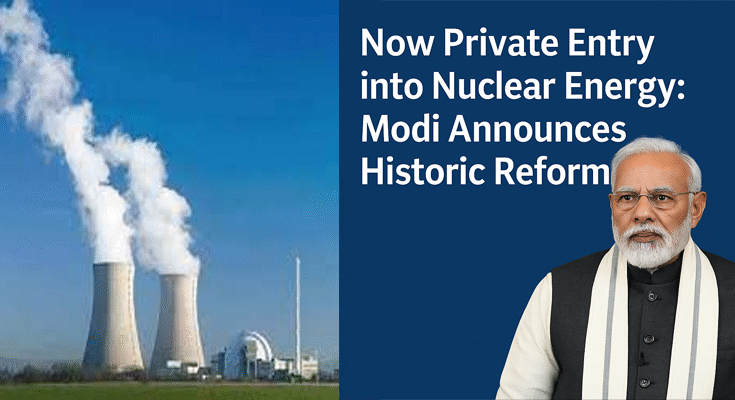

India is entering a new phase of economic and energy transformation. Moreover, for the first time in the nation’s history, Prime Minister Narendra Modi has announced that private companies will be allowed to participate in the nuclear energy sector, a domain that has remained exclusively government-controlled for decades. Consequently, this policy shift is expected to accelerate innovation, investment and clean-energy expansion across the country. Additionally, the reform supports India’s long-term vision of becoming a global clean-energy leader while reducing dependence on fossil fuels.
According to reports, this historic shift is expected to be formalized through the Atomic Energy Bill, 2025, which is likely to be introduced in the upcoming parliamentary session.
Reference: Times of India – “India’s nuke policy: PM Modi announces plan to open nuclear sector to private players.”
Why this Reform Matters
Until now, nuclear power generation in India has been managed solely by the Nuclear Power Corporation of India Ltd (NPCIL) and the Department of Atomic Energy (DAE). However, opening the sector to private participation marks a major policy overhaul. Furthermore, it could help expand nuclear capacity faster than before and close the gap between rising energy demand and production. As a result, the reform carries potential economic and environmental benefits for the coming decades.
This is especially crucial for India, where energy demand is expected to double by 2040 due to rapid industrial growth and urbanization.
What Will Private Participation Look Like?
As per the announcement and official discussions, private companies are expected to participate in multiple stages of India’s nuclear ecosystem. In particular, they may support research and development, including reactor design and advanced fuel technology. Additionally, they may contribute to manufacturing critical nuclear components and assisting with the construction and maintenance of nuclear plants. Ultimately, this could pave the way for a new wave of innovation in next-generation reactors, such as Small Modular Reactors (SMRs).
One of the biggest expected growth areas is SMRs (Small Modular Reactors) — compact reactors that can be deployed faster and require lower investment.
Reference: International Atomic Energy Agency – SMR deployment insights
Benefits Expected from nuclear sector privatization
✔ Faster expansion of clean-energy infrastructure
Private capital and operational efficiency can reduce project delays and boost energy output.
✔ Job and industry growth
Opening the sector may generate opportunities across:
Engineering
Manufacturing
Research
Critical minerals
Security & compliance
✔ Technology modernization
Private firms can support development in:
Digital monitoring
AI-powered safety systems
Automation
Next-gen reactors
✔ Reduced dependency on coal
Increasing nuclear output helps phase out polluting fossil fuels without risking energy security.
Concerns & Challenges Raised by Experts
While the policy has been widely appreciated, experts have also urged caution. On the other hand, some sections of the nuclear scientific community have raised concerns about safety, regulatory preparedness and long-term liability rules. Moreover, questions remain about how responsibility will be shared between government agencies and private firms in the event of an incident. Therefore, a strong compliance framework will be essential to ensure that the reform is both safe and sustainable.
🔹 Safety & regulatory risk
Nuclear energy requires absolute compliance with radiation management and disaster-prevention protocols.
🔹 Liability and insurance
Experts debate how responsibility will be shared between government and private players in case of incidents.
🔹 Technology transfer
Some nuclear technology remains protected by global treaties, limiting cross-border collaboration.
🔹 Public trust
Nuclear projects often face local resistance due to environmental and safety fears.
What This Means for India’s Global Standing
With this reform, India positions itself alongside countries that encourage public–private synergy in nuclear energy, such as:
United States
France
Japan
South Korea
Strategic partnerships with global nuclear leaders can bring:
Advanced fuel cycles
Faster project deployment
Low-waste reactor designs
This step is expected to strengthen India’s global influence in the clean-technology and strategic energy sector.
What Happens Next?
The following developments are expected in the coming months: the introduction of the Atomic Energy Bill, 2025 in Parliament, followed by the creation of a regulatory framework for licensing private companies. After that, safety and liability guidelines will likely be finalized by the authorities. Eventually, joint ventures with NPCIL may begin, particularly in pilot projects involving Small Modular Reactors (SMRs). If these steps unfold smoothly, nuclear energy could become one of India’s top power sources by 2045.
Read our recent trending article: Corporate Burnout 2025 – A Growing Workplace Crisis
https://protronmedia.com/corporate-burnout-in-2025/
Final Thoughts
PM Modi’s decision to open the nuclear sector to private companies is not just a policy announcement — it is a strategic milestone in India’s technological future. If executed responsibly, it could:
- Accelerate nuclear energy capacity
- Attract massive domestic & international investment
- Boost job creation and high-tech manufacturing
- Strengthen clean-energy independence
However, its success depends on well-crafted regulation, transparency, safety standards and long-term planning.
India stands at a historic inflection point — redefining how the world views nuclear energy, innovation and private participation.