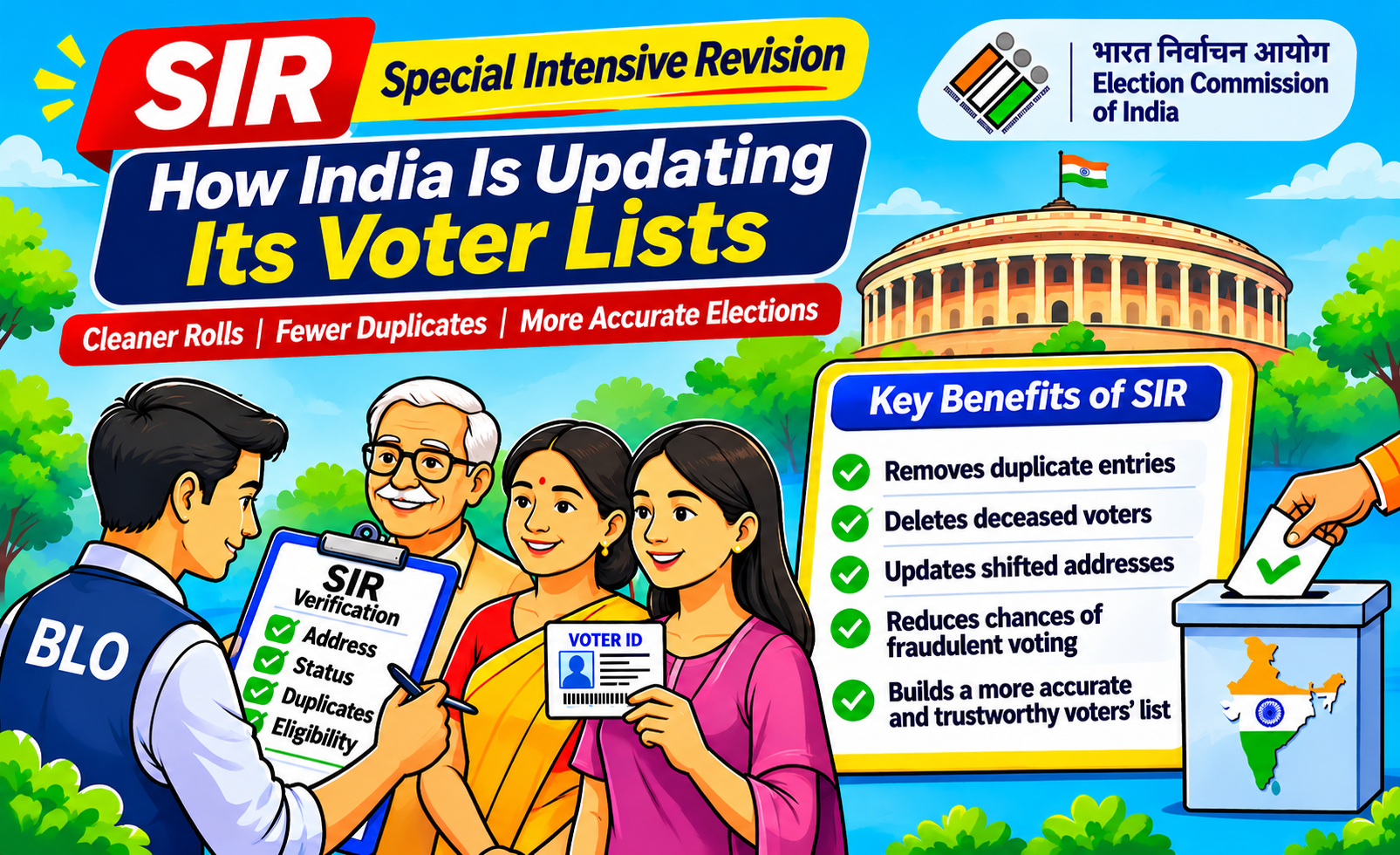




How India Is Updating Its Voter Lists to Make Elections More Accurate and Transparent

What Is SIR and Why Has It Become a National Debate?
India’s electoral system depends on one essential document: the voter list. For an election to be fair and credible, this list must accurately represent eligible voters in every constituency.
To improve the accuracy of electoral rolls, the Election Commission of India (ECI) is conducting a Special Intensive Revision (SIR) across states and Union Territories.
Unlike a routine update, SIR involves intensive verification of voter details, including house-to-house enumeration by Booth Level Officers (BLOs). Its stated objective is straightforward: ensure that every eligible citizen gets the opportunity to vote, while removing entries that should no longer exist in the electoral roll.
The exercise has also triggered a nationwide debate. While the Election Commission highlights the need to eliminate outdated and duplicate entries, opposition parties and civil society organisations have raised concerns about eligible voters potentially being left out.
So, what does SIR actually aim to achieve, and how can it improve India’s election process?
1. Why Does India Need SIR?
Electoral rolls are not static documents. Over time, several changes can make voter records inaccurate:
- Deceased voters: Names may remain on voter lists even after a person’s death.
- Duplicate registrations: A person may appear more than once or be registered in multiple constituencies.
- Permanent migration: People who have permanently shifted may continue to appear at their previous address.
- Incorrect information: Spelling mistakes, outdated addresses and other errors can affect voter records.
- Unverified entries: Some entries may require further verification when voters cannot be contacted.
If these records are not regularly checked, the electoral database can become outdated and less reliable.
SIR is intended to address these issues through a more detailed verification exercise.
2. How Can SIR Improve India’s Election Process?
A properly conducted SIR can offer several important benefits.
A. Removing Duplicate Voter Entries
One person should not have multiple active registrations in different constituencies. Identifying and correcting duplicate entries can make electoral rolls more accurate and reduce the possibility of misuse of multiple registrations.
B. Updating Records of Deceased Voters
Removing verified entries of deceased persons helps ensure that voter lists reflect the living, eligible electorate. It also reduces the risk of someone attempting to misuse outdated voter records.
C. Identifying Permanently Shifted Voters
When people permanently move to another location, their voter registration should reflect their ordinary residence. SIR can help identify outdated registrations and support the updating of records.
D. Strengthening Electoral Database Accuracy
A verified voter database helps election officials plan polling stations, estimate voter numbers and manage election arrangements more effectively.
E. Improving Public Confidence
Accurate records, transparent verification and publicly available draft lists can help citizens, political parties and election officials identify discrepancies before the final electoral roll is published.
An important distinction: Removing a duplicate or outdated registration helps prevent possible misuse, but it does not automatically prove that fake voting has taken place. Any allegation of actual electoral fraud must be supported by evidence.
3. What Safeguards Are in Place to Protect Genuine Voters?
Cleaning up voter lists is important, but protecting every eligible citizen’s right to vote is equally important.
According to information provided by the Union Ministry of Law and Justice to Parliament on July 25, 2026, the Election Commission has outlined several safeguards:
- BLOs conduct house-to-house verification.
- At least two to three attempts are to be made before a voter is treated as untraceable.
- Reasons for proposed deletions must be recorded under the prescribed procedure.
- Draft electoral rolls are published before finalisation.
- Citizens can submit claims and objections through the prescribed forms.
- Appeals can be made before designated appellate authorities, with further recourse to the Chief Electoral Officer.
- Booth Level Agents appointed by political parties can help identify discrepancies.
- The ECI has also described supervisory cross-checks and random sample audits of deleted entries.
These safeguards are important because a person being temporarily unavailable, travelling or living away from home should not automatically lose their voting rights.
The Supreme Court, in its May 27, 2026 judgment, recognised the Election Commission’s legal authority to conduct SIR under the relevant election laws and its constitutional responsibilities. The process must still follow applicable legal procedures and provide routes for addressing wrongful exclusion.
4. The Latest Development: Voter Roll Revision Continues
The revision process is moving forward in different phases.
According to the Election Commission’s schedule dated October 15, 2026, a Special Summary Revision (SSR) is being conducted in 17 states and Union Territories, with January 1, 2027 as the qualifying date.
Key dates include:
- November 12, 2026: Publication of integrated draft electoral rolls.
- November 12 to December 11, 2026: Period for filing claims and objections.
- December 28, 2026: Scheduled deadline for disposal of claims and objections.
- January 4, 2027: Scheduled final publication of electoral rolls.
The Commission has also directed a special drive to enrol eligible young and first-time voters.
This is particularly significant because electoral roll revision should not only correct existing records; it should also make sure that newly eligible citizens are included.
5. Why Is SIR Facing Criticism?
Despite its stated objectives, SIR has raised serious concerns.
Opposition parties and civil society groups have questioned whether the verification process could lead to the exclusion of genuine voters, particularly elderly citizens, migrant workers, economically weaker sections and people who may struggle to produce documents or respond to notices.
Human Rights Watch, in an October 28, 2026 report, criticised the large-scale exclusions associated with the revision and raised concerns about the impact on vulnerable communities.
The scale of the exercise makes transparency essential. A name should not be removed merely because a voter was unavailable during a visit or because of a documentation difficulty.
The Election Commission’s stated safeguards, public disclosure of draft rolls and effective grievance redressal therefore need to work properly at the ground level.
6. What Should Every Indian Voter Do?
Regardless of political views, checking one’s voter registration is a practical step every eligible citizen should take.
Citizens should:
- Check their name in the latest electoral roll.
- Verify their address and personal details.
- Contact their BLO if any information is incorrect.
- Submit the appropriate claim or correction form within the notified period.
- If their name is missing, apply for inclusion through the prescribed process.
- Keep acknowledgement and application details for future reference.
Citizens can use the Election Commission’s official voter services portal:
The Bigger Picture: Accurate Voter Lists, Stronger Democracy
SIR brings an important question into focus: how can India maintain an electoral roll that is both accurate and inclusive?
Removing verified deceased, duplicate and outdated entries can improve the integrity of the voter database. At the same time, no eligible citizen should be denied the opportunity to vote because of an administrative error, a missed verification visit or a documentation challenge.
The success of SIR should therefore be judged on two equally important outcomes:
1. No ineligible or duplicate entry should remain after proper verification.
2. No eligible Indian citizen should lose the right to vote because of a wrongful deletion.
A clean voter list and an inclusive voter list are not competing goals. Both are essential for a credible electoral process.
Ultimately, the strength of Indian democracy lies not just in conducting elections, but in ensuring that every eligible citizen can participate and every vote is protected.
What do you think? Can SIR make India’s electoral rolls more accurate while ensuring that no genuine voter is left behind? Share your views.
Editorial Note: The article distinguishes the Election Commission’s stated objectives and procedures from concerns raised by critics. Claims of actual fake voting or deliberate manipulation should not be treated as established facts without independent evidence.